Industrial Architecture Services Mexico
Discover the definitive guide to Industrial Architecture Services in Mexico. Learn how top architects in Mexico City adapt to nearshoring, leverage advanced BIM coordination, and design high-efficiency, LEED-certified industrial facilities.
The global manufacturing and logistics landscape is undergoing a massive structural shift. Driven by supply chain resilience, geopolitical realignments, and the unprecedented boom of nearshoring, Mexico has positioned itself as the premier industrial hub for the North American market. For multinational corporations, institutional funds, and logistics developers, establishing an operational footprint in the region is no longer just a trend—it is a core strategic mandate.
However, setting up high-performance manufacturing plants, distribution centers, or advanced logistics parks requires more than just land acquisition. It demands world-class engineering, precise execution, and sophisticated design. This guide provides an exhaustive analysis of industrial architecture services in Mexico, detailing how top-tier architects in Mexico City and regional industrial hubs are transforming raw corporate requirements into globally competitive, high-efficiency, and sustainable built environments.
1. The Nearshoring Boom and the Evolution of Industrial Architecture in Mexico
Historically, industrial structures in Mexico were viewed as purely functional containers—utilitarian warehouses constructed with basic metal sheets and concrete slabs, where the primary objective was minimizing initial capital expenditure (CapEx).
In today's market, that paradigm is entirely obsolete. The modern influx of high-tech industries, such as automotive electric vehicle (EV) manufacturing, aerospace components, medical devices, and advanced electronics, has fundamentally elevated the standards of industrial architecture across the country.
Traditional Warehouse ──> Advanced High-Tech Manufacturing ──> Sustainable Smart Industrial Park
Modern industrial architecture in mexico now operates at the intersection of high engineering, environmental responsibility, and advanced digital coordination. Global corporations expect their facilities to comply with strict international building codes, achieve aggressive energy-efficiency targets, and provide superior workplace conditions that attract and retain specialized talent. Consequently, industrial architecture services have transitioned from basic draftsmanship to high-level strategic consulting and comprehensive multidisciplinary engineering.
2. Core Industrial Architecture Services: From Site Selection to As-Built Delivery
A professional, top-tier architectural firm in Mexico does not just deliver a set of construction blueprints. They manage a highly complex, data-driven lifecycle that ensures financial, legal, and structural viability. The scope of services typically includes:
2.1. Industrial Master Planning and Site Analysis (Due Diligence)
Before a single line is drawn, architectural teams conduct rigorous site due diligence. In Mexico, this is an essential phase to mitigate long-term financial risks.
- Zoning and Land Use (CUS and COS): Verifying municipal regulations regarding maximum built areas and building heights.
- Infrastructure Feasibility: Assessing the availability of medium-voltage power connections, industrial-grade water supply, and data connectivity.
- Topographic and Soil Mechanics Coordination: Analyzing soil load-bearing capacities, which dictate the engineering of heavy-machinery foundations and specialized floor slabs.
2.2. Architectural Concept and Spatial Layout Optimization
Industrial facilities must be designed from the inside out. The architectural layout must perfectly mirror the client’s industrial process—whether it is a linear assembly line, a cellular manufacturing matrix, or a high-density racking system for e-commerce fulfillment. Architectural services focus on optimizing internal circulation, eliminating cross-contamination of workflows, and planning flexible, large structural spans that allow the building to adapt to future technological modifications.
2.3. Advanced MEP (Mechanical, Electrical, and Plumbing) Engineering
Industrial operations are highly energy-intensive. Therefore, the coordination of building services is often the most critical component of the project executive phase.
| Engineering Discipline | Critical Industrial Components | International Standards Applied |
|---|---|---|
| Electrical Engineering | Substation design, medium and low voltage distribution, emergency backup generators, busway systems, and clean grounding grids for automated robotics. | NEC (National Electrical Code) / NOM-001-SEDE |
| HVAC & Ventilation | Process cooling, dust extraction, cleanroom climate control, positive/negative pressure management, and high-efficiency chillers. | ASHRAE Standards |
| Fire Protection Systems | Early Suppression Fast Response (ESFR) sprinklers, industrial fire pumps, specialized fire barriers, and smart smoke detection arrays. | NFPA Standards (National Fire Protection Association) |
| Hydraulic & Waste Water | Industrial effluent treatment plants, greywater recycling networks, and high-volume storm water retention infrastructure. | CONAGUA regulations |
2.4. BIM Coordination and Digital Twin Management
Leading architects in Mexico City utilize advanced BIM (Building Information Modeling) methodologies. Instead of flat 2D lines, facilities are built virtually as multi-dimensional data models. This digital transformation allows for automated clash detection—ensuring that massive HVAC ducts, heavy structural steel columns, and complex electrical cable trays never physically collide on the construction site. This technology slashes on-site errors and prevents costly, time-consuming change orders during the construction phase.
3. The Shift Towards Green Industrial Buildings: Sustainability and Certifications
In the contemporary corporate landscape, environmental, social, and governance (ESG) criteria heavily influence institutional real estate investments. Global firms require their industrial facilities in Mexico to minimize environmental impact and significantly lower long-term operating expenses (OpEx).
Passive Bioclimatic Design
Top industrial architects design high-performance building envelopes. Rather than relying solely on high-powered, energy-consuming air conditioning systems, smart architectural design incorporates passive solar control.
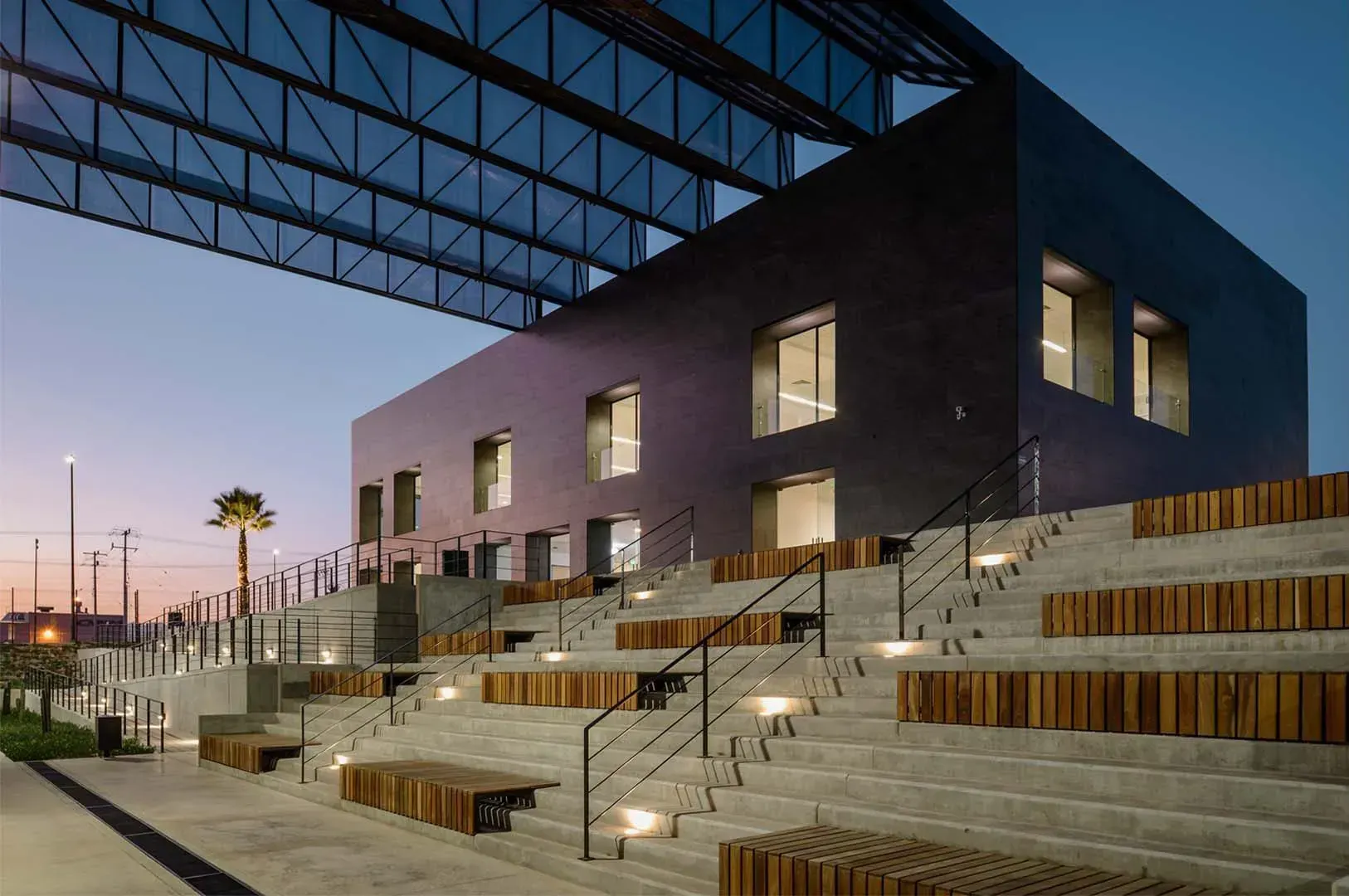
A prime example is the implementation of engineered, perforated metal skins and secondary ventilated facades—a technical hallmark seen in vanguard projects across central Mexico, such as the Joysonquin facility designed by ICONICO. These facades act as thermal shields, drastically reducing solar heat gain while optimizing uniform, natural daylighting on the production floor.
International Certifications: LEED and EDGE
- LEED (Leadership in Energy and Environmental Design): Achieving LEED Gold or Platinum certification has become a baseline requirement for AAA industrial parks in Mexico. It validates that the facility excels in water efficiency, energy atmosphere optimization, indoor environmental quality, and sustainable materials sourcing.
- EDGE (Excellence in Design for Greater Efficiencies): An innovation of the International Finance Corporation (IFC), a member of the World Bank Group. EDGE focus heavily on quantifiable metrics, requiring a minimum 20% reduction in energy, water, and embodied carbon in materials compared to regional baselines.
LEED / EDGE Certification ──> Lower Utility Bills + Reduced Carbon Footprint = Higher Active Asset Value
4. Financial Landscape: Cost Distribution in Mexican Industrial Architecture
Understanding the financial structure of industrial projects in Mexico is vital for cross-border developers. While industrial design is highly cost-effective in Mexico compared to the United States or Europe, the allocation of capital reflects a highly technical, infrastructure-driven budget.
Parametric Cost Distribution for High-Specification Facilities
- Mechanical, Electrical, and Plumbing (MEP) Infrastructure (35% - 40%): Substation connections, industrial HVAC, automated controls, compressed air lines, and fire suppression arrays.
- Structural Engineering and Civil Works (30% - 35%): Deep foundations, structural steel framing, insulated sandwich panel roofing, and high-flatness concrete floor slabs (f'c = 300 kg/cm or higher, designed for heavy forklift loads).
- Architectural Finishes, Facades, and Offices (15% - 20%): Bioclimatic curtain walls, corporate office interiors, employee amenities (such as biofílico dining halls and medical centers), and exterior landscaping.
- Executive Project, BIM Modeling, and Permits (6% - 10%): Comprehensive architectural design, structural calculations, environmental impact studies, and local construction licensing.
5. Navigating the Legal and Regulatory Framework in Mexico
One of the greatest advantages of partnering with established architects in Mexico City is their deep understanding of the local and federal regulatory matrix. Executing an industrial project requires navigating multiple institutional layers:
- SCT (Secretaría de Infraestructura, Comunicaciones y Transportes): Crucial for logistics parks requiring direct access to federal highways or rail networks.
- CONAGUA (Comisión Nacional del Agua): Manages water drilling permits, deep well concessions, and industrial wastewater discharge approvals.
- SEMARNAT (Secretaría de Medio Ambiente y Recursos Naturales): Mandates comprehensive Environmental Impact Assessments (MIA - Manifestación de Impacto Ambiental) before any industrial development can break ground.
- Local Municipalities: Issue land-use alignments, environmental licenses at the state level, and the definitive Building Permit (Licencia de Construcción).
An experienced architecture firm acts as the lead coordinator, aligning all engineering disciplines to ensure that the executive project smoothly complies with these regulatory bodies without causing project delays.
6. The Future of Industrial Spaces: Human-Centric and Elastic Architecture
Looking ahead, industrial architecture is moving beyond pure mechanical efficiency to embrace human-centric and elastic design principles.
The Rise of Industrial Biofilia
Modern industrial architecture recognizes that worker well-being directly impacts operational productivity. The integration of natural light, indoor green spaces, and high-quality ventilation systems reduces absenteeism, lowers cortisol levels, and boosts operational efficiency. Industrial facilities are no longer designed in isolation; they include high-end corporate office spaces, employee wellness centers, and outdoor recreational zones that treat the factory worker as a premium corporate asset.
Structural Elasticity (Future-Proofing)
Industrial technologies evolve at an exponential rate. A facility designed for manual assembly today may transition to fully automated AGVs (Automated Guided Vehicles) and smart robotics tomorrow. Top industrial architects design with structural elasticity—utilizing large clear structural spans, high vertical clearance (clear heights of 32 to 36 feet or more), and modular MEP distributions that allow the internal layout to be completely reconfigured with minimal disruption to the building shell.
7. Conclusion: Partnering for Global Competitiveness
In the competitive macroeconomic climate of Mexico, industrial architecture has evolved into a vital tool for business strategy. Investing in top-tier industrial architecture services is the single most effective way to protect your capital investment, guarantee international operational standards, and create high-value, sustainable real estate assets.
At ICONICO, we combine the rigorous precision of high engineering with the vanguard vision of contemporary architecture. Our deep expertise in BIM methodologies, bioclimatic envelopes, and international compliance allows us to guide global companies smoothly through their expansion into Mexico, transforming technical corporate mandates into iconic, highly productive architectural realities.
8. Technical Glossary of Mexican Industrial Architecture
- BIM (Building Information Modeling): A collaborative digital methodology that uses intelligent 3D models to manage the physical and functional characteristics of a facility throughout its lifecycle.
- Clash Detection: An automated process within BIM software that identifies spatial conflicts between different engineering disciplines (e.g., an HVAC duct intersecting a structural beam) before construction begins.
- COS (Coeficiente de Ocupación del Suelo): The municipal building code factor that determines the maximum footprint or ground area an industrial building can occupy on a specific piece of land.
- CUS (Coeficiente de Utilización del Suelo): The municipal building code factor that determines the maximum total built square footage allowed across all levels of a facility.
- Due Diligence: The comprehensive preliminary analysis of a property’s legal, technical, and environmental status before proceeding with land purchase or architectural design.
- ESFR (Early Suppression Fast Response): High-volume, fast-acting ceiling sprinkler systems designed specifically to protect high-piled storage and logistics warehouses without requiring in-rack sprinklers.
- MIA (Manifestación de Impacto Ambiental): The official Environmental Impact Assessment required by federal and state authorities in Mexico to evaluate and mitigate the ecological footprint of a proposed industrial development.